Why Matching Storage Containers Can Make a Cupboard Harder to Use
Matching storage containers can make a cupboard harder to use. Group supplies by shared tasks, then choose containers that make everyday items easy to reach and put back.
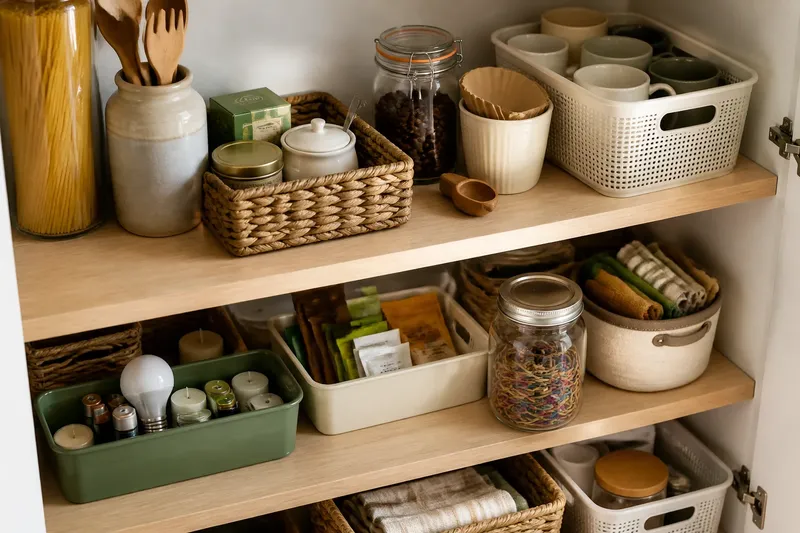
The common mistake with matching storage containers is buying a neat set before deciding what needs to live together. A cupboard may look orderly at first, yet take longer to use when tea bags sit beside baking supplies simply because both fit the same tubs. Grouping by shared tasks makes items easier to find and return.
Why group cupboard items by task?
Start with the actions that happen in the cupboard, not the shape of its contents. If you make tea, you might reach for tea bags, a tin of sugar and a spoon together. Keeping those items near one another gives the group a clear purpose, even if they come in mismatched packaging.
This is task-based storage: arranging things around a repeated activity rather than around colour, material or container type. It suits small cupboards, where dividing everything into separate matching tubs can add extra steps. A single basket might hold tea supplies, while a nearby shelf holds mugs.
How should frequently used combinations be placed?
Storage should reflect how often an item is used and what it is used with. Everyday breakfast supplies may belong on a reachable shelf; a pastry cutter used occasionally can sit higher up. The aim is to avoid making a familiar task require several separate searches.
Say you keep coffee, filters and a scoop in a kitchen cupboard, but the filters are in a matching container on another shelf. Move the filters beside the coffee and scoop. The expected result is that making coffee involves fewer cupboard searches; the containers need not match for the group to make sense.
Which container shapes suit different contents?
Uniform containers can leave awkward gaps or waste useful space. A tall jar suits spaghetti or wooden spoons; a shallow tray suits small packets; a broad basket can corral flexible bags. Choose a container that holds a particular group comfortably and can be reached without disturbing everything around it.
Reuse what you already have when it suits the job. A sturdy shoebox can hold spare candles, a clean jar can keep rubber bands together, and a small tray can gather batteries awaiting sorting. Check that reused containers are clean and sound, and follow relevant maker’s instructions or local rules where they apply.
When does a container make loose items easier to manage?
A container earns its place when it stops small or irregular items from spreading, or lets you lift a whole task group at once. It is less useful when it adds a lid, a label and another object to move just to reach something used every day.
An open basket can suit sachets or spare light bulbs if you want to see what is inside. A lidded box may suit rarely used seasonal decorations that benefit from being kept together. Keep the distinction practical: open for frequent access, enclosed when items need protection or can be stored away.
How can you make the arrangement easy to put back?
A system is only as useful as its return path. If a container is difficult to slide out, too heavy to lift, or so full that its contents catch, people may leave things on the shelf instead. Leave room to remove a basket without shifting neighbouring items, and avoid packing small groups into cumbersome containers.
Labels can help when a cupboard is shared, but they should describe the contents or task in plain language. “Tea” is more useful than a decorative label that only makes sense to the person who arranged the shelf. If the contents change often, a removable paper label or no label may be easier to maintain.
What should you check before settling on a storage arrangement?
- Check whether the items are used for the same task; if they are, store them together, and if not, give them separate groups.
- Check whether the group fits the shelf without blocking neighbouring items; if it does, keep the container there, and if not, try a shallower tray or another shelf.
- Check whether you can see and reach frequently used contents; if you can, leave them in place, and if not, move them to an open container or a more accessible spot.
- Check whether the container can be lifted or slid out without shifting other things; if it can, use it for the group, and if not, choose a lighter or easier-to-reach option.
- Check whether the container is clean and sound; if it is, reuse it where suitable, and if not, clean it first or choose another container.
- Check whether a lid protects something that is rarely used; if protection helps, keep the lid, and if it slows everyday access, use an open basket or tray instead.
- Check whether a label still describes the contents; if it does, keep it, and if not, replace it with a plain label or remove it.
What questions help you choose cupboard storage?
Should all cupboard containers match?
No. Matching containers can look consistent, but they are not automatically the easiest fit for different items or tasks. Choose them only when their shape and access suit what you plan to store.
How do you choose a container for a cupboard?
Consider the item’s shape, how often you use it and whether you need to lift the group out together. An open tray, jar or basket may be more convenient than a lidded box for everyday supplies.
What is a useful way to group household supplies?
Keep together the items commonly used for the same activity, such as baking ingredients and tools or shoe-care supplies. Then place the group where that activity is easiest to carry out.
How can you organise a cupboard without buying new boxes?
Gather related items and see whether existing baskets, jars or trays already hold them well. Reuse a container only if it is clean, stable and suitable for its contents.
How can storage keep pace with changing routines?
Household supplies change as routines change. A new hobby, a visiting family member or a different breakfast habit can make yesterday’s grouping inconvenient. Leave some room in containers so a group can absorb an extra packet or replacement item without forcing a cupboard reset.
Review the arrangement when you notice a repeated snag: the same item keeps landing on the counter, or one basket becomes a mixture of unrelated supplies. Move the items according to the task they serve now. You do not need to replace the whole set of containers to make the cupboard work differently.
Matching storage containers can still be useful when they fit a cupboard and make a set of items easier to handle. But a cupboard is not a display shelf: its arrangement should help you complete ordinary tasks and return things without fuss. Start with what belongs together, then choose containers that support that relationship rather than letting the containers decide it.